Start with the governing document
Professional bobsleigh development begins with the International Bobsleigh & Skeleton Federation document library. Identify the discipline, competition context and applicable edition before extracting requirements. A summary on a website, including this one, cannot replace the governing documents or an official interpretation. Rules can change, and an apparently minor amendment can affect a drawing, inspection fixture or purchasing decision.
Create a requirements register rather than a loose folder of screenshots. Each entry should identify its source, the relevant clause, the component affected, the proposed verification method and the person responsible. Separate explicit requirements from team preferences. “Must satisfy the applicable mass requirement” is a compliance issue; “should allow convenient workshop access” is an engineering objective. Both matter, but they should not be approved through the same process.
Build an envelope, not a silhouette
A legal outer shape is only one part of a workable design. The architecture must accommodate athletes, steering, frame attachments, inspection access and the runner assemblies. Define interfaces early: where loads enter the structure, which surfaces establish alignment and which adjustments remain available after assembly. A change that fits in a rendering may still obstruct an inspection point or make a worn component difficult to replace.
Use a controlled coordinate system across drawings and models. State datums, tolerance assumptions and the condition in which a dimension is measured. An unloaded frame on a bench is not necessarily geometrically identical to the assembled system under representative loading. That difference does not automatically indicate a defect, but it does require a consistent definition of the measurement condition.
Make mass a system decision
Mass allocation connects structural design, athlete configuration and permitted adjustment. Do not reduce the problem to making every component as light as possible. A lighter part may require additional reinforcement elsewhere or move the available mass distribution away from the intended configuration. Assess the complete assembled system against the applicable rules, rather than treating a component’s mass as an independent performance score.
A useful budget assigns a measured or estimated mass to each assembly and records the confidence in that value. Update the budget after manufacturing and repair. Adhesive, coatings, fasteners and local reinforcement can accumulate into a meaningful difference between the nominal model and the real sled. Preserve enough margin for realistic manufacturing variation, while avoiding unsupported numerical rules of thumb.
Design inspection into the hardware
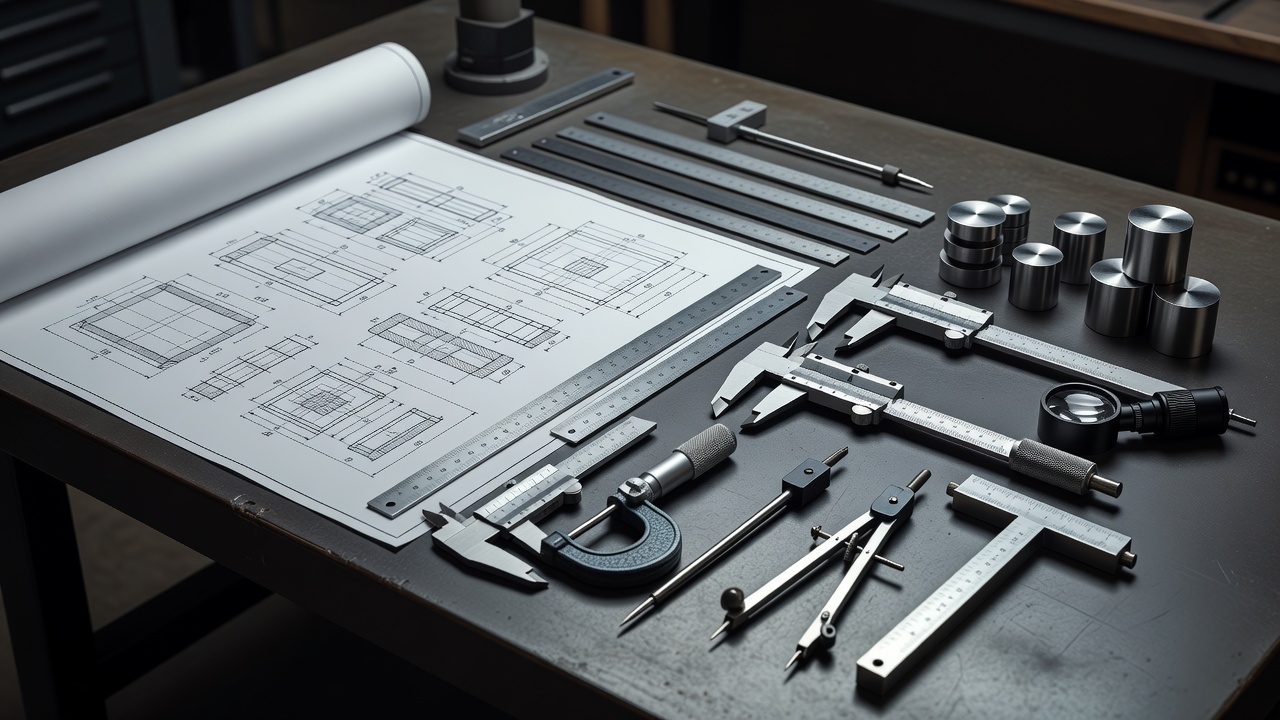
Inspection is most useful when planned before tooling. Ask which features can be reached with ordinary measurement equipment and which require a dedicated fixture. Consider whether assembly hides a critical surface, whether a gauge can be positioned repeatably and whether the instrument resolution is appropriate for the tolerance. An elaborate inspection report is weak evidence if the measurement setup is unstable.
The ISO 9001 quality-management framework offers a general reference for controlled processes; it is not a bobsleigh eligibility certificate. Likewise, the JCGM measurement publications hosted by BIPM support uncertainty thinking without supplying sport-specific acceptance limits. Use each source for the question it actually addresses.
Control the changes that matter
Every meaningful configuration needs an identity. Record the drawing revision, material documentation, assembly settings and inspection results. If a runner mounting interface changes, the shell model may remain untouched while the system behaviour still changes. Configuration control should therefore cover the relationships between components, not just their individual part numbers.
Hold a review before irreversible work. Check unresolved rule interpretations, supplier capability, tooling assumptions and repair options. The purpose is not to freeze learning; it is to ensure that a later test can be connected to the hardware that produced it. A clear rejection or an unresolved question is more useful than a nominal approval with undocumented exceptions.
Keep the context in view
National organisations such as British Bobsleigh & Skeleton Association, Bob- und Schlittenverband für Deutschland and USA Bobsled/Skeleton provide context on the sport and its teams. They are distinct from the international technical rule source. Do not infer that an association, manufacturer or governing body endorses a design merely because its public information informed your research.
The handover to aerodynamics should now be precise: a legal design envelope, known interfaces, an initial mass budget and a list of assumptions. That foundation allows a shell study to explore useful options without repeatedly solving constraints that should already be controlled.